On: transference, countertransference and projective identification

Photo by Markus Spiske on Pexels.com

In this essay, I define the psychoanalytic concept of transference and its development in the hundred plus years since Freud’s discovery. I illustrate it with a clinical example of a patient’s transference to me. I follow by using the same structure; define, historicise and illustrate, for the concepts of countertransference and projective identification. How countertransference is used differs by analytic school and I make a reference to the differences between Freudians, Kleinians and Independents. These foundational concepts do not belong to the consulting room only. I reference how they inform the psychosocial worlds, notably race, before concluding.

Transference is a process. Its key is ‘displacement’, displacing an unconscious idea, from the object to which it was once attached, and on to the analyst. For Freud, what was transferred was a window into unconscious assumptions, via feelings that properly belong elsewhere (Frosh, 2012). In his ‘Dora’ case study, Freud (1905) had defined transference as “new editions or facsimiles of the impulses and phantasies … aroused during the progress of the analysis”. Transference, then, is the “actualisation of unconscious wishes” (Laplanche and Pontalis, 1967) and a form of the mother-infant dyad (Winnicott, 1960), an illusion where someone, not consciously recognised, represents something, which forms the basis for a repetition of a relationship with an important historic figure (Sandler, Dare and Holder, 1973). The impulses (Freud, 1937) have their source in the earliest object relations and come forth as a consequence of the compulsion to repeat. The analyst works to strengthen the analysand’s ego, so that there is less displacement and the gap between fantasy and reality becomes better understood.

Its discovery and its evolution began with the attachment formed by a patient of Freud’s colleague, Breuer, later anonymised as ‘Anna O’. (Freud, 1893). Freud’s original frustration with transference, that it was a resistance to the analysis, shifted to recognition that it made the therapeutic alliance about emotion (Freud, 1910, 1912, 1914). Freudians consider that treatment is about recognising how the analysand’s transference is informed by an attempt to gratify drives, designed to reduce unpleasure (Lemma, 2016). Freud’s initial focus, was on erotic and romantic transference. Therapy was effected by love, and early appreciation of what is now described as positive transference. The negative transference, (Klein, 1952) when an analysand brings forth hostile feelings from developmental relationships, was not really considered until Klein’s work. Kleinians believe hostility is linked to the death instinct, and that hatred and envy are innate. Klein also hypothesised that what might be transferred on to the analyst might be parts of the analysand’s self, such as the superego, rather than historic relationships. (Klein, 1952, 1957). Transference today is more a projection (Kleinian) model than a displacement (Freudian) one. Post-Kleinians, including Winnicott and Bion, look at the transference developmentally. Just as the mother receives the projections of the infant and moderates and mitigates, so that the infant can receive them back, so the analyst behaves for the patient. The analyst needs to remain alert and thoughtful, in a state of ‘reverie’ (Bion, 1962). All of the communications from the patient “contain something relevant to the transference situation”. (Segal, 1981)

To illustrate the concept, I share an experience from my personal clinical work: I have been working with a patient, ‘A’, who was largely raised by a disciplinarian stepfather, who appears to have had little affection for his stepson. His biological father left when he was three. In the transference, I am sometimes the stepfather: ‘A’ splits an eagerness to please me, to get it ‘right’, but also an anxiety that he will draw my ire. ‘A’’s childhood in his stepfather’s home was, as he recalls it, dominated by the demands to be useful, by completing a number of chores. At the outset of the therapy, he talked about decorating the NHS consulting room, if he had the right tools. I understood A’s inner world to be shabby and neglected, and his need to show he could be useful, and compliant. This is evidence of displacement, as are other times, when I sense I become A’s father, albeit idealised, as someone who was understanding and interested. What emerges then, is A’s infantile desire to be interpreted and loved. In my countertransference, I feel something parental and am reminded of the unconscious desire many therapists have to repair, something Klein (1952) highlights.

Countertransference like mine, is unresolved, unconscious elements within the analyst (Freud, 1910), evoking intense feelings. (Carpy, 1989) The analyst has an unconscious reaction, identifies the analysand’s role in bringing it about, and then examines the effect on both parties (Money-Kyrle, 1956). Freud had regarded it as an impediment that should be resolved by the analyst developing more ego strength in their own analysis. No analyst is “wholly free of infantile dependence” (Racker, 1948) and feelings and impulses are determined by the past, meaning that aspects of the Oedipal situation are repeated in every countertransference. Forty years after Freud’s anxieties about countertransference, Heimann (1950) redefined it as “an instrument of research” into the patient’s unconscious, because the analyst’s unconscious understands that of his patient. The analyst, is both an interpreter and an object of the impulses felt by the patient. Klein (1952), although prioritising the child’s phantasy life and unconscious phantasies, held similar views to Freud, claiming that only by analysing “the transference situation to its depths” could the past in both real and phantasy be understood.  However, it is the ‘post-Kleinians’ (Bion, 1959, Segal 1975, Rosenfeld, 1987) that have been at the forefront of countertransference’s development. Currently, it is usually defined as being both the analyst’s own transference and the analyst’s response to the analysand’s transference.

Despite the significance of Ferenczi and Alice Balint’s views, that the analyst’s own feelings should be shared with the analysand (Heimann, 1950), little was written about countertransference until the end of the 1940’s (Racker, 1948). In developing Klein (1946), Winnicott (1947), had been amongst the first to grasp its significance for working with psychotic patient populations when describing hatred towards the patient. This is relevant for our contemporary understanding of issues like racism, founded upon the “irrationality of the unconscious” (Timimi, 1996). It was Heimann, though, that encouraged a more constructive view of something she felt was created by the patient; the aforementioned instrument of research. Klein (1952), who prioritised the child’s phantasy life and unconscious phantasies, rarely used the term countertransference until writing about the infantile roots for both parties in seeking ‘reassurance’ (1957). Ten years after Heimann, writing that the analyst needed to ‘sustain’ and not ‘discharge’ feelings, the word countertransference was “in danger of losing its identity” according to Winnicott (1960). He was inclined to Freud’s view and defined countertransference as “neurotic features” disturbing the analysis and spoiling the analyst’s “professional attitude.” Independents and post-Kleinians have been at the forefront of subsequent development, making it a “fertile, intersubjective field” (White, 2006). Winnicott (1963) and Bion (1965) looked at it developmentally, and Ogden (1994) has made it more about intersubjectivity, with his concept of the ‘analytic third’. More contemporary views are that the analyst should allow themselves to participate in the enactment required by the patient’s projections, in order to become conscious of the phantasy and emotion (Rosenfeld, 1971, Joseph, 1989, Bollas, 1987,1992).

In my work with a woman, ‘B’, I often find myself struggling to concentrate. I wonder if she is making me mad (Winnicott, 1960). I find myself wanting the sessions to come to an end and notice her need for attention, but how I seem to be resisting giving it. Her mother was diagnosed as schizophrenic, after ‘B’ reached adulthood. Her father left pre-adolescence and had a second family, so she has half-brothers. Everything about her world and world view appears to be influenced by splits. Her maternal care and her parents’ divorce concretised her views, I believe, and pulled her back from a developing depressive position to paranoid schizoid (Klein, 1946). I experience her as happiest when complaining about her family, friends, colleagues, and employment. I, guilty with inattention, sense a whining child, starved of gratification. Racker (1953) would suggest the patient is emotionally blocking and I am succumbing to “pampering”, initiated by my guilt at my wandering attention. By pampering, I re-focus intently and become a good Object for ‘B’, as the father was before he left. Sometimes my countertransference is paternally protective, (Money-Kyrle, 1956), but I think I often act out the neglectful mother, creating a guilt, which is a consequence of my inability to be a necessary container for her anxieties (Bion, 1959, 1962). This acting out has made me sympathetic to the Joseph, Rosenfeld and Bollas approaches.

Projective Identification, (PI), pre-dates Heimann’s constructive view of countertransference but had already transformed the transference/countertransference dynamic from a displacement to a projection focus (Klein, 1946). PI is an unconscious, omnipotent phantasy best captured by the lay phrase ‘giving someone a piece of my mind’. It is not everything that makes up the countertransference, (Heimann, 1950), but invariably seems to be the dominant feature in a therapeutic relationship; most commonly manifested as a part of the patient’s self, projected into the object (Segal, 1964) and where the projector is psychically aligned with the person into whom it has been projected. This is done, with the aim not simply of expulsion, but of using the projection to control the therapist, (Segal, 1981) inducing feelings or thoughts or by provoking forms of enactment. The object is transformed by the projection (Feldman, 2009). The projector fantasises taking over the therapist and influencing the recipient so that they think and respond in a way that is congruent with the projection (Ogden, 1982). The therapist processes what is projected, so that it can be palatably returned and the projector can introject what had needed expelling.

PI has been taken up by many theoreticians, notably Bion (1959, 1970), who adapted it by identifying what was projected as ‘beta elements’ that the therapist made sense of thanks to utilising ‘alpha function’, and then being able to reproject them. He considered that PI was understood as ‘a three-dimensional space’, into which patients projected the parts of their personality that they had split off. Klein thought that this was ‘observable’ in psychotic and borderline patients and Bion agreed with her that the ‘degree of fragmentation’ and the distance to which split-off fragments were projected was a measure of the distance a patient had from contact with reality. In his studies of the containment process (1959,1962), he observed how a mother takes in and allows herself to be affected by her infant’s projection of distress. The mother/analyst has not only contained an experience but transformed it. For some, enactment opens analytical work to “deep unconscious identifications and primitive levels of functioning” which are beyond the reach of the intellect, (Tuckett, 1997) albeit recognising one’s own feelings can be difficult (Brenman-Pick, 1985)

One of my experiences of PI came from a patient, ‘C’, presenting as depressed and unable to develop relationships. ‘C’ earned his PhD at Oxford, where his father was a fellow, while his grandfather was a celebrated and distinguished medic. He now edited a well-known scientific magazine, but felt his achievements were inferior to his family history, and he was ‘phoney’. (Winnicott, 1960). In our early work, he let me know that he thought that psychotherapy was “pointless”. Anyone working in the NHS, was probably unable to develop a private practise. He projected feelings of inferiority into me, in order to rid them from himself (Rosenfeld, 1987) and to enable him to adopt the superior status he associated with his father and grandfather. I found myself identifying with the intellectual inferiority, responding by making theoretical and technical interventions in the sessions. I became the boy he had been, desperately trying to show my academic and intellectual accomplishments to a demanding father. I was compliant and beginning a “defensive collusive arrangement” (Feldman, 2009).  I had acted out something congruent with what had been projected into me, seeking attention and admiration. Once I became aware of what was happening, we were able to think about the competitive need for superiority. Eventually, he was able to introject the split off part and to accommodate it, recognising that he was still seeking parental love.

The concepts of transference, splitting and PI are fundamental to our psychosocial world. Klein (1952) asserted that transference operated throughout our lives influencing all relationships. Transference includes other significant figures beyond the parental couple, taking in the realm of the collective social unconscious. The social world contains multiple projected and introjected transference contents. External events, such as those affecting race or gender often catalyse a regression in psychic functioning activating defences. (Hamer, 2006) ‘D’, a Pakistani male patient of mine, projected his feelings of being unwelcome, on to outbursts against the Polish builders working on his apartment block, because of their use of their native tongue. He wanted to rid himself of being identified as an immigrant Other, and identify with my white, native born status. Reciprocal projective identifications can establish a preferred element of the self in the white. (Timimi, 1996). He may also have harboured suspicions of my unconscious and unexpressed attitudes to race. Racism might be transference in a regressed state (Hamer, 2006) characterised by splitting of the self, obscuring the ‘true self’ (Winnicott, 1960) to protect it from annihilation. Splitting is the psychoanalytic basis for racism (Timimi, 1996)

I have defined and illustrated the concepts of transference, countertransference and projective identification. In my work, I find I incline more to the Freudian displacement of past relationships, than to Kleinian split off parts of the self, but appreciate the contemporary use of enactment, intellectually and affectively. I like Racker’s (1948) observation that psychoanalysts choose their work based on “the object relations of infancy” and because of its reparative nature (Money-Kyrle, 1956), which seems rather Kleinian. Her assertion that transference operates all through our lives, influencing every relationship, is why I believe we need to apply what we can learn in the clinic to the world beyond; what the IPA’s podcast characterises as psychoanalysis “off the couch”. It requires a longer essay to do justice to the great psychosocial themes of race, ethnicity, religious marginalisation, sexual identity and fluidity, as well as social constructs around ‘normality’, disability and social class, but I have demonstrated the power of the unconscious, and how something once perceived as an impediment, is now a critical therapeutic tool.

References:

Balint, A & Balint, M. (1939) On transference and countertransference. International Journal of Psychoanalysis 20.  pp.225-230

Bion, W.R. (1959) Attacks on Linking. International Journal of Psycho-Analysis, 40, pp. 308-15

Bion, W.R. (1962) Learning from Experience. London: Heinemann.

Bion, W.R. (1965) Transformations: Change from Learning to Growth. London: Heinemann.

Bion, W.R. (1970) Attention and Interpretation New York: Basic Books

Bollas, C. (1987) The Shadow of the Object: Psychoanalysis of the Unthought Known. London: FAB

Bollas, C. (1992) Being a Character: Psychoanalysis and Self-Experience London: Karnac

Brenman Pick, I. (1985). Working Through in the Countertransference. International Journal of Psycho-Analysis, 66, pp.157-166

Carpy, D.V., (1989). Tolerating the countertransference: A mutative process. International Journal of Psycho-Analysis70, pp. 227-241.

Feldman, M (1997) Projective identification: the analyst’s involvement International Journal of Psycho-Analysis78, pp.287-294.

Feldman, M. (2009). Doubt, Conviction and the Analytic Process: Selected Papers of Michael Feldman Hove, East Sussex. Routledge.

Freud, A (1937) The Ego and the Mechanisms of Defence. London: Hogarth Press Ltd.

Freud, S (1893) The Psychotherapy of Hysteria. In: SE2 Complete Psychological Works of Sigmund Freud pp. 253-305

Freud, S (1905) Fragment of an Analysis of a Case of Hysteria. In: SE7 Complete Psychological Works of Sigmund Freud

Freud, S (1910) The future prospects of psychoanalytic therapy. In: SE11 Complete Psychological Works of Sigmund Freud

Freud, S (1912) The Dynamics of Transference. In: SE12 Complete Psychological Works of Sigmund Freud pp. 97-108.

Freud, S (1914) Remembering, Repeating and Working Through. In: SE12 Complete Psychological Works of Sigmund Freud pp. 145-156

Frosh, S. (2012). A Brief Introduction to Psychoanalytic Theory. Basingstoke: Palgrave Macmillan.

Hamer, F. (2006) Racism as a Transference State Psychoanalytic Quarterly 75(1) pp. 197-214

Heimann, P (1950) On Countertransference International Journal of Psychoanalysis 31.  pp. 81-84 

Hinshelwood, R. (1999) Countertransference. International Journal of Psychoanalysis 80.  pp. 797-818 

Joseph, B. (1985). Transference: The Total Situation. International Journal of Psychoanalysis 66.  pp.447-454

Joseph, B (1989) Psychic Equilibrium and Psychic Change: Selected Papers of Betty Joseph London: Routledge

Klein, M. (1946) Notes on Some Schizoid Mechanisms. International Journal of Psychoanalysis 27 (3).

Klein, M (1952). The Origins of Transference. In Envy and Gratitude and Other Works London: Hogarth Press Ltd.

Klein, M (1957). Envy and Gratitude. In: Envy and Gratitude and Other Works London: Hogarth Press Ltd.

Laplanche, J. and Pontalis, J-B. (1967) The Language of Psychoanalysis London: Hogarth Press Ltd.

Lemma, A. (2016) Introduction to the Practice of Psychoanalytic Psychotherapy Chichester: John Wiley & Sons Ltd.

Money-Kyrle, R.E. (1956) Normal Counter-Transference and Some of its Deviations. International Journal of Psychoanalysis 37 (3) pp. 360-66

Ogden, T (1982) Projective Identification and Psychotherapeutic Technique New York: Jason Aronson

Ogden, T (1994) The analytic third: working with intersubjective clinical facts. International Journal of Psychoanalysis 75.  pp. 3-19

Racker, H. (1948) The Countertransference Neurosis. In: Transference and Countertransference. Abingdon, Oxon: Routledge.

Racker, H (1953) The Meanings and Uses of Countertransference. In: Transference and Countertransference. Abingdon, Oxon: Routledge.

Rosenfeld, (1971) Contribution to the psychopathology of psychotic states. In: E. Spillius (ed.) (1988) Melanie Klein Today: vol 1, Mainly Theory. London: Routledge.

Rosenfeld, H. (1987) Listening and Interpretation. Therapeutic and Anti-therapeutic Factors in the Psychoanalytic Treatment of psychotic, borderline and neurotic patients London: Tavistock Publications.

Sandler, J., Dare, C., and Holder, A. (1973) The Patient and the Analyst London: Maresfield Library

Segal, H. (1964) Introduction to the Work of Melanie Klein New York: Basic Books.

Segal, H (1981) The Work of Hanna Segal New York: Jason Aronson

Timimi, S (1996) Race and Colour in Internal and External Reality. British Journal of Psychotherapy 13(2) pp. 183-192

Tuckett, D (1997) Mutual Enactment in the psychoanalytic situation. In: The Perverse Transference and Other Matters: Essays in Honor of R. Horacio Etchegoyen.

Winnicott, D.W (1947) Hate in the countertransference In: Through Paediatrics to Psycho-Analysis London: Hogarth Press Ltd

Winnicott, D. W. (1960) Countertransference. In: The Maturational Processes and the Facilitating Environment London: Hogarth Press Ltd.

Winnicott, D.W (1963) Psychotherapy of Character Disorders. In: The Maturational Processes and the Facilitating Environment London: Hogarth Press Ltd.

White, J. (2006) Motivational echoes: Transference and countertransference in contemporary theory. In: Generation – Preoccupations & Conflicts in Contemporary Psychoanalysis. Hove: Routledge

You talking to me? True and False Selves.

The skill of an actor in being able to persuade the audience that they are someone else is one of the things I most admire. And yet, we all act, some more than others. The trope of the comedian making people laugh through his depression, is another way we might think about presenting an altered self. We act to disguise, or often, to protect something of ourselves. I have often prepared myself for social or for professional occasions by assuming a mask. I look back nearly seven years after leaving my City career, and I wonder how much of what I displayed was the “real me”. In other words, how much was character and how much the actor?

When I was a little younger I often found myself commentating, in my head, on my life. I looked at myself from some other perspective and described myself, my actions and my thoughts like a novelist writing about somebody else. I was looking at myself as a character. Not all of this is healthy. I had split something off from myself and I was losing touch with my core.

Professional roles sometimes require an adoption of a false self. It can be unhealthy. The most extreme professional examples are well-known in the literature of organisational or business psychology. Most oft-quoted is that of the air crew staff on long-haul flights. The need to maintain a smiling, reassuring and welcoming face and attitude, in the face of often rude, demeaning, sexual comments and attitudes, from sometimes over-refreshed, occasionally inebriated customers, leads to something called cognitive dissonance, when all the exterior signals have to confound what is happening to someone’s inner thoughts and feelings. It is exhausting and is an accelerator to burnout and breakdown.

Photo by Kelly on Pexels.com

Paediatrician turned psychoanalyst, Donald Winnicott wrote a very fine paper about the True Self. I have read it a number of times. At times it can be dense, but at others it seems very clear to me, and it also describes a phenomenon that I recognise in myself. Given that he notes that it is a defence – in more Freudian terms it is a means of protecting the ego – I wanted to understand it better. The False Self is often a high functioning identity and appears to be someone with few issues to observers, but the inability to be ‘whole’ generates huge psychic strain.

The great novelists and dramatists understood this. Seeking one’s identity is a familiar plotline. Oliver Twist is forced to adapt and adopt different personae, but the point of Dickens’s story is that his true self triumphs. Why? Because of love. More interesting are the dilemmas that trouble characters who become slaves to their false selves. I think that is why Mad Men’s ‘Don Draper’ aka Dick Whitman, was so compelling. The true self cannot be lost, however submerged it becomes. In a slightly different storyline, we watch Breaking Bad’s ‘Walter White’ become a slave to his ‘Heisenberg’ self, and it contrasts with Draper, who instantly reinvents himself, whereas White suffers as he shifts selves.

Photo by Alena Shekhovtcova on Pexels.com

In the brilliant film ‘American Fiction’, the protagonist, Monk, adopts a writing identity to appeal to the publishing industry. He intends it to parody what is being published and bought, but becomes dizzied by the success of what he produces and then the need to be faithful to his false identity. His false self literally overwhelms his true self. It tortures him. The author, Percival Everett, of the novel on which the film is based, ‘Erasure’, has just written a new novel, based on the world seen through the eyes of Huckleberry Finn’s companion, Jim. It too, is about protecting a True Self.

Jim becomes James, is well-read and familiar with philosophy, and is an extreme example of the phenomenon of ‘code switching’. In reality, code switching is unfunny. It is a conscious defence adopted to protect someone from being attacked for their true identity, invariably linked to ethnicity. It is quite usual for all of us in social or professional fields to want to present our best selves, or a version of our self that we think will be most attractive to the company we are keeping. I do not think of this as deceit, or malign, but a wish to be accommodating and engaging. That comes from a positive intent, whereas code switching is a linguistic attempt to fit in with a dominant culture and avoid negative attention and hostility. One might concede that this is negative selection.

It was listening to Everett on a recent “Private Passions’ interview with Michael Berkeley on Radio 3, and reading a review of his latest book in this month’s LRB, that made me revisit Winnicott, and also to think about how much, or little of my True Self, I reveal. Winnicott begins, by acknowledging that the concept of a true self appears “in certain religions and philosophical systems”. If a false self exists, he asks how it arises, what its function is, why does it often become exaggerated, do people exist without a false self, and if so why, and finally what could be named a True Self.

He compliments Freud’s early work dividing the self into that “powered by the instincts”, which I take to mean the id, and “a part that is turned outwards and is related to the world”, which I think means the ego. In his opening clinical example, he writes about a middle-aged woman who had a very successful False Self. It is not clear what he means here by “successful”, but it made me think about a number of former colleagues and clients during my City career.

This woman, despite and also because of her “successful False Self”, “had the feeling all her life that she had not started to exist”. When I read that I thought of my internal commentary on this character called Ian Burns. He writes that “she had always been looking for a means of getting to her True Self”. I admire the work of a former JP Morgan employee called Lucy, who left the industry to teach yoga, breath work and to expand her own self-development and now helps other young professionals to escape the cage they have built for themselves, sometimes unknowingly, and to seek their True Self. (At least that is how I interpret the brilliant work she does). Look her up.

Winnicott continues, by noting that he found himself analysing someone who he thought of as her “Caretaker Self”. This was the self that understood the loss of something true and core and had at least taken her to analysis, and slowly became able to hand over “its function to the analyst”. It was the evolution of the case that allowed Winnicott to understand that a False Self is defensive, designed “to hide and protect the True Self”.

Back to my experiences of life in the City, it is important to appreciate that a False Self can often be a high functioning individual. Outward appearances are of a ‘success’. Something however, let us call it a ‘Whole Self’, is lacking and professional and personal relationships begin to fail. Winnicott thinks these are extreme cases – the ‘True Self’ is hidden.

In less extreme examples, the False Self defends the True Self, but the True Self is “acknowledged as a potential and is allowed a secret life”. He describes it as a clinical illness “as an organisation with a positive aim”. Recovery, or perhaps development would be a better word, comes from the False Self finding the conditions to allow the True Self to come into its own. Failure can lead to suicide because it “is the destruction of the Total Self in avoidance of the annihilation of the True Self”.

Nonetheless, the False Self can sustain and not necessarily seek destruction and annihilation. What does it look like in this apparently healthy manifestation? It is “represented by the whole organisation of the polite and mannered social attitude”, which is what I believe I saw frequently amongst my erstwhile colleagues and clients. Winnicott also highlights how intellectual individuals have a tendency for the “mind to become the location of the False Self”, developing a “dissociation between intellectual activity and psychosomatic existence”. I believe this is relevant to my burnout experience in 2012.

When I look back to the self I was at the time, I now believe that my error that precipitated my career crisis was a form of self-sabotage initiated by my unconscious. I was enjoying a period of professional success and status, but in his paper Winnicott refers to “the very real distress of the individual concerned, who feels ‘phoney’ the more he or she is successful”. Such individuals “destroy themselves in one way or another, instead of fulfilling promise…”

So, where does the False Self come from? What is it defending? Right at the beginning of life, Winnicott refers to an “unintegrated” infant, yet to distinguish between itself and an Object, and so working with what he calls the “environment mother”. Anything, gestures that the infant makes ‘spontaneously’, are the True Self, but if the mother fails to meet the omnipotence of the infant repeatedly, the infant can only note the substitution of the mother’s gesture and comply with it. This is the foundation of a False Self.

Ask yourself if you have a tendency towards being compliant? “The True Self does not become a living reality except as a result of the mother’s repeated success in meeting the infant’s spontaneous gesture or sensory hallucination.” Instead, the infant builds a set of false relationships “so that the child may grow to be just like mother, nurse, aunt, brother, or whoever at the time dominates the scene”. The False Self’s compliance with environmental demands hides the True Self. Compliance often develops into skilled imitation.

A True Self allows for reality, but the “existence of a False Self results in feeling unreal or a sense of futility”. When does it appear? “The True Self appears as soon as there is any mental organisation of the individual at all, and it means little more than the summation of sensori-motor aliveness”. He cites an example of a woman who felt that the first fifty years of her life had been “wasted” and sought a sense of “aliveness”. She was not in touch with her core, her essence. When I used to commentate on myself, I did not know what I was doing, but now I think that I might have been observing something that was not truly alive.

Winnicott believed there were degrees of False Self application, from “the healthy, polite aspect of the self” to the more damaged and damaging, “truly split-off compliant False Self”. It is this that is mistaken for the “whole child”, or the ‘real’ adult. He thought that it led to “a poverty of cultural living”, which leads to a lack of appreciation of a cultural life and instead, “extreme restlessness, and inability to concentrate”.

In the final analysis, one asks of both oneself and of others “Who are you?” The greatest privilege is being seen, and accepted for who we are. It’s love – the sort that a parent has for a child – and what an adult seeks in a partner. Showing our true selves means being vulnerable like the neonate, it means accepting dependence, and it is of course, very uncomfortable, which is why there is a psychic need to defend it from any sort of attack or what Winnicott called “impingement”.

The fictional characters I have highlighted all find themselves becoming detached from the person they believe themselves to be. They also feel that revealing their True Self would have awful consequences. I understand the point about annihilation and suicide that Winnicott made. Not being a “phoney” is much more difficult than it can seem. For couples, when one partner has not been able to be honest and fears revealing a whole self, it leads to despair and a sad void where something is sensed but cannot be discussed or understood. My own analysis is, to reference another psychoanalyst, Wilfried Bion, introducing me to myself and recognising the years of defensive self-deception.

The post-COVID world. How will it be for you? (1)

Idea, World, Pen, Eraser, Paper
What next?

In the immediate aftermath of the Global Financial Crisis the newest graduates from Harvard’s prestigious Business School were treated to an address from Clayton Christensen. The theme was “How Will You Measure Your Life” (HBR, Aug. 2010). Christensen wanted graduates to think about how they would think in future, with what were likely to be many untypical challenges ahead of them. 

In the past week, perhaps because of the lamentable, confused new government advice to “stay alert”, I have noticed a shift in mood, thoughts, temperament and media coverage of the lockdown experience. There is much greater engagement with ideas of what comes next. This was part of what Christensen wanted the newly-minted grads to consider.

Several of my friends and correspondents are debating what changes we might like to see and what a post-COVID world might mean for us all, but few of us have yet felt much change beginning externally, or within ourselves. Perhaps we need to be inconvenienced for longer and to see what the depth of the recession will do to our friends and families. 

Christensen’s address made me think of Daniel Kahneman’s book “Thinking Fast and Slow”. We have emotional and cognitive responses to all new ideas, concepts, shapes and people that are presented to us. There is nothing wrong with instinctive responses, but Christensen wanted to have graduates aware of when instinct and impulsivity inhibit good logical processes. This is especially hard in emotional fields like love and friendship, but still worth considering. I will come on to that when considering some of my friends’ responses to their lockdowns. 

Thinking, Fast and Slow
Emotional and Cognitive responses

Christensen asked graduates to ask themselves a) how can I be happy in my career? b) how can I be sure my family is an enduring source of happiness and c) how can I stay out of jail? There was nothing cute seeking a cheap laugh about the third question. Two of his 32 Rhodes Scholar class had spent time in jail, and his HBS cohort included Enron’s Jeff Skilling. 

What is your key motivator? For some it is money. In my ‘First Innings’ it was highly prized by me, although I am not sure it was my key motivator. Frederick Herzberg, author of the 2-Factor Hygiene-Motivator Theory, suggests it is the opportunity to learn, to contribute to others and to be recognised. That fits more with my ‘Second Innings’. 

The order of Christensen’s questions is deceptive. He noted that HBS reunions were littered with increasing numbers of allegedly ‘successful’ men (very few women) who were divorced and often estranged from their children. They had strategised successfully for their career, but it had been to the detriment of family lives. Without exception, all were a little broken by the experience. I am hearing from several friends that the lockdown has started them on a path to reappraise their career, and its importance to them. Have a strategy for family life. It sounds clinical and unnatural, but is true. 

My own experience is that I have the great fortune to have loving relationships with each of my children, but I still see the fact that I am divorced from their mother as something of a personal failure. I think that I am happier now, than when I was married, and I think my ex is too, but not gathering the family together, as we would have anticipated when our third was born, nibbles away at my self-esteem occasionally. 

Christensen told the graduates, “people who are driven to excel have this unconscious propensity to underinvest in their families and overinvest in their careers.” This is done in the sure knowledge that loving family relationships are the most enduring source of happiness in our lives. He was a man who had a deep faith. I do not, but all of us can sense something in these following words. “I’ve concluded that the metric by which God will assess my life isn’t dollars but the individual people whose lives I have touched”. 

I think that is elegant and profound. Talking to my friends about my Second Innings, I hear many of them thinking about what they want from the last half of their lives. The COVID-19 lockdown may be accelerating some of these processes. I have one dear friend who is struggling with the unresponsiveness of a man for whom she has deep admiration. She has decided for her own health that she needs to break from waiting for him to suddenly deepen their friendship into a romance. He has never misled her, but she has decided to avoid misleading herself.

Chess - Simple English Wikipedia, the free encyclopedia
Your move…

I have another friend who is agonising over breaking up his own family to pursue a new relationship. He is a fine and thoughtful man, who loathes the hurt that he knows will be inflicted on his spouse and his children. His love interest will also be breaking up a family unit. But, they are young(ish) and have known each other for decades, and know in their hearts and minds that they are best suited for one another. Locked down with partners that neither see as the person with whom they wish to grow old is a different form of purgatory, not least because of the deceit they continue to have to practise at home. 

Yet another friend is recovering from discovering that the man she thought would be making a home and a life with her, has decided that he cannot leave his marriage, despite having spent months asserting that was his need and desire. Apparently being locked down has reminded him how much pleasure he takes from his young teenage children. Before they flee his nest, he now intends to try to rebuild his marriage. 

Almost everyone I talk to is going through some sort of mental recalibrating. What do they want? What do they need? And, as Christensen asked “How will you measure your Life?”. The sports car, the directorship, the smart postcode lavish address. Ultimately these are ephemera and rarely provide what we think we want. Helping others, being respected and recognised, as Herzberg suggested, are perhaps better measures. 

In a recent interview, James Corden explored how people may be being changed by COVID-19 with author, Alain de Botton. I am a huge fan of de Botton’s “School of Life” and he had posted some materials about how it was time to “rethink our lives”. He suggested this particular plague might be “a gift”. It was forcing people to re-connect. It was generating fresh respect and regard. We were all getting better at acknowledging humanity in the people around us, and not just in Thursday night claps. He felt the pressure to strive and achieve was making way for the “good enough’ ideas of psychoanalyst, Donald Winnicott. 

Time was given to the Stoic philosophers, and learning to prepare for the disappointment of life. De Botton noted that we are becoming more adept at being friends to other people, but that that was far from unusual. What was important was learning to be a friend to oneself, which anyone exploring therapy and analysis knows is a much more demanding challenge.

But, if you, like me, are thinking about what a post-COVID world looks like on a personal level, and perhaps thinking about your own ‘Second Innings’, de Botton’s advice is good, “be ambitious about how we want to live”. In other words, think like Christensen, of how one might measure a life. 

On Perspective

Gormley’s figures throw perspective and conceptions of what is normal

Last week I visited the Antony Gormley exhibition at the Royal Academy, with my favourite art historian, my eldest, for company. The week before I had seen the Blake exhibition at the Tate, with different, but equally charming and well-informed art appreciation company. I was glad to have the opportunity to share my impressions with my experts, but the more I get to observe works of art, the more I understand how personal they are.

What struck me about the Gormley exhibition was how the word ‘perspective’ kept coming to the front of my mind. It may be something the artist strives to achieve. Maybe not. I knew little of his work other than ‘The Angel of the North’, which is certainly a work of art that demands perspective. The word kept recurring in my mind as I walked through the rooms.

Perspective is defined as ‘a particular attitude toward or way of regarding something’. It may be no coincidence that I am sensitive to perspective, given several months of my own analysis as part of my psychoanalytic psychotherapy training. Art does convey meaning. Jung developed the idea of the archetype; an image or thought with universal meanings across cultures that could show up in a dream, in literature, in art or in religion. Gormley’s images and sculptures certainly scream meaning. They provoke thought. He is a sculptor who uses his own body as a place rather than an object, and attempts to explore the space of the body as a condition shared by all humanity.

I regard myself as a bit of a philistine when it comes to visual and physical art, but I have changed as I have aged, helped by having an art historian in the family. Even so, I went into this exhibition with low expectations for what I might like, but a good deal of curiosity. It starts provocatively with a small sculpture of a baby outside on the floor of the rather grand courtyard entrance off Piccadilly.

I believe it is supposed to say something about fragility and Gormley has said that “this tiny bit of matter in human form attempts to make us aware of our precarious position in relation to our planetary future”. It was created in 1999, and so pre-empts Greta and XR, by twenty years, with its central theme. When I passed it again on my way out I realised that it fitted with my impressions of the importance of perspective from the exhibits indoors. 

Through thirteen rooms and forty years of work I gained a sense of the sculptor’s thinking, and his love of scale and bold materials. All the while I was being interrogated by my psyche about what it made me feel. I kept coming back to psychoanalysis, which emphasizes unconscious mental processes and is sometimes described as “depth psychology.” The deeper one goes, the more one’s perspective alters. Think of descending to the bottom of a well and how the ground level and the sky represent themselves differently as the perspective alters. 

In the first room, his earliest works are displayed. I almost tripped over one, which lies down the middle of the room and in over fifty lead cases laid out in a line, exhibits the growth of an apple from first petal through ripening and ultimately to a mature fruit. Youth and age are different perspectives. Tripping is easy to do given the attention drawn to the work hanging on the walls, which attract the eyes’ attention first.

The oldest piece, a wall drawing, “Exercise Between Blood and Earth” proved to be one of my favourites, and using sliced bread to convey meaning, as in his “Mother’s Pride V”, reminded me that the best artists have a sense of fun, and can be anarchic and subversive in their approaches.

“Everything we hear is an opinion, not a fact. Everything we see is perspective, not the truth.”Marcus Aurelius

Over a week later and I can still see most of the exhibits in my mind’s eye, so it clearly made a strong impression. Describing them all is pointless, but having to negotiate the trapped space around “Clearing VII” which is 8km of aluminium tube that is described as a ‘spatial field’ and a ‘bundle of nothing’ in the second room, is to appreciate art’s physicality. It demonstrates that we do not need to be too deferential and awestruck with art, as we are required to be in some of the great galleries of the world that keep us a respectful distance from what we have come to see. 

“Matrix III” is worth the admission alone. A hanging steel ‘cloud’ that disrupts one’s idea of what is ‘cloud like’. How can so much steel be suspended? I felt like I do every time I am at an airport, and still marvel at how planes get off the ground and then stay in the air. It is not all heavy metals and grand statements; a room full of his drawings provokes a good deal of thought, especially the use of his own blood as an ink, but I realised when seeing “Cave” in room 10, that it was ‘perspective’ that was coming back to me as my theme and also, as a series of questions. 

“Cave”is described by the RA as “sculpture on an architectural scale”, where “jostling cuboid structures” are arranged above the visitors but where one is encouraged to enter the exhibit by walking through a constricted metal passageway. I came out and said to my daughter, because we had had to crouch to get through and grope in the dark, that it had put me in mind of a WWI movie set for a trenches scene. I have since heard it compared with the movement of a neonate through the birth canal, which is about as Freudian as I can imagine. 

Consequently, “Cave” and “Iron Baby” demand thoughts about perspective. My work in my own analysis is about how I see myself and my perception of how others might see me, and if that should matter. If it does, why does it matter to me? According to Freud, the behaviours, perceptions, and decisions we make can be observed consciously by the ego, and are recognized as a given result of cause and effect, but are often driven by the unconscious processes of the mind.

“The mind is like an iceberg, it floats with one-seventh of its bulk above water .” – Sigmund Freud

From the Jungian perspective, psychological suffering is a signal that something in us needs some attention, and certain states of anxiety and depression are no exceptions. Jung’s perspective on the concept of humanity is one that reflects an understanding that people are complex. What defines a person will often go down into the depths of the mind deeper than what can easily be explored. A bit like the perspective from the individual descending a well. In my case, it is a mine shaft that appears in a not untypical dream that I sometimes have.

Another great psychoanalyst, Donald Winnicott, used true self, to describe a sense of self based on spontaneous, authentic experience and a feeling of being alive, having a real self. The false self, by contrast, he saw as a defensive façade, which, in extreme cases, could leave its holders lacking spontaneity, feeling dead or empty. One’s perspective, it seems to me, defines whether one is in touch with a true, or a false self. I grew up with an image of who I was, or wanted to be, and failed to nurture my true self. I am far from alone. Sometimes it is called ambition or aspiration; at its most destructive, it is a form of perfectionism, that leads to an inability to ever be satisfied and in many cases to depression. 

“The only person with whom you have to compare yourself is you in the past.” – Sigmund Freud

My earlier visit to the Tate was a complete contrast to the Gormley exhibition, but I now realise that perspective was a link. The two exhibitions could hardly be more contrasting: One is dominated by scale and the range of mainly heavy materials. The other is almost exclusively represented on paper in multiple exhibits per room, because the scale is small. It does not shout its messages any less loudly, but it is eloquent with detail and precision. 

“If the doors of perception were cleansed, everything would appear to man as it is — infinite.” William Blake

One artist is alive, and we can ask him what he thinks and he intended, and is representing. The other is very much dead. On the subject of perspectives, one artist’s work is physical and feels ‘of its time’, even if a forty-year-old wall drawing was amongst my favourites, whereas the other is much more spiritual. Its beauty and messaging seem altogether less bound by time. What both artists have in common is a willingness, indeed a need, to challenge convention. Blake was far from universally admired, indeed exhibiting left him with quite a financial loss, but Gormley seems to have earned financial security, even if he too is subject to vehement criticism. 

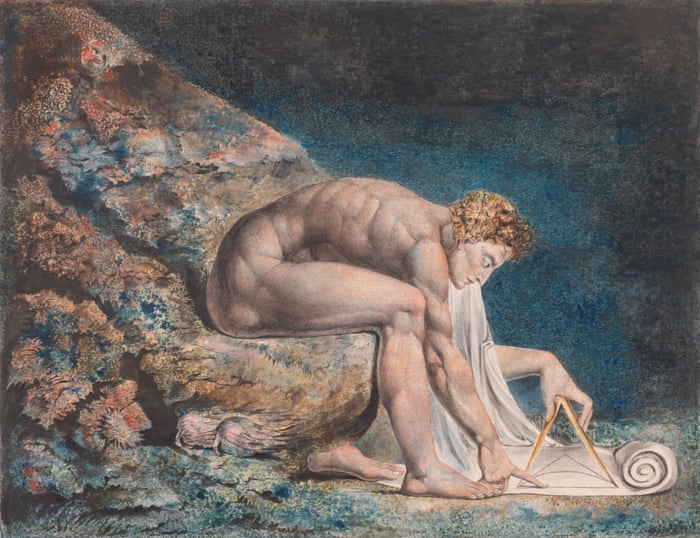
Blake has been described as art’s original free spirit. He did not see it, the way others did. At times he seemed to be railing against science, and the Age of Reason, and invariably ‘the Establishment’. He would feel at home in modern London, I suspect. Guardian journalist, Laura Cumming had this to say, “In his visions, the devil may be tragic, tortured by interminable regret; and God may be violent, uprooting Adam like a weed from the earth. Horror is not always frightening. One illustration of hell shows a smoking serpent front of stage in a kind of glamorous limelight.” He was a pioneer too, he created the technique of relief etching and certainly invited fresh perspective considerations.

Whilst I was thinking about these exhibitions, about the psyche and about perspective, I went to see the film “Official Secrets”. In its way, it too is about perspective – about moral laws and legal laws; about being true to the self or being true to one’s government and nation. It is very good, and not just because I am a huge Keira fan, but because one perspective is about the smallness of the individual, against the immensity of the State. Perhaps it is related to scientific understanding, like the butterfly’s wing sensitivity and its impact. To me it reminds us not to underestimate our value, not to be overwhelmed by a tyrannical superego, to appreciate and value both ends of the scale spectrum, in both the physical word and in the psychic world. 

“If you don’t like a person it’s because they remind you of something you don’t like about yourself.”Sigmund Freud