


Last week I visited the Antony Gormley exhibition at the Royal Academy, with my favourite art historian, my eldest, for company. The week before I had seen the Blake exhibition at the Tate, with different, but equally charming and well-informed art appreciation company. I was glad to have the opportunity to share my impressions with my experts, but the more I get to observe works of art, the more I understand how personal they are.
What struck me about the Gormley exhibition was how the word ‘perspective’ kept coming to the front of my mind. It may be something the artist strives to achieve. Maybe not. I knew little of his work other than ‘The Angel of the North’, which is certainly a work of art that demands perspective. The word kept recurring in my mind as I walked through the rooms.
Perspective is defined as ‘a particular attitude toward or way of regarding something’. It may be no coincidence that I am sensitive to perspective, given several months of my own analysis as part of my psychoanalytic psychotherapy training. Art does convey meaning. Jung developed the idea of the archetype; an image or thought with universal meanings across cultures that could show up in a dream, in literature, in art or in religion. Gormley’s images and sculptures certainly scream meaning. They provoke thought. He is a sculptor who uses his own body as a place rather than an object, and attempts to explore the space of the body as a condition shared by all humanity.
I regard myself as a bit of a philistine when it comes to visual and physical art, but I have changed as I have aged, helped by having an art historian in the family. Even so, I went into this exhibition with low expectations for what I might like, but a good deal of curiosity. It starts provocatively with a small sculpture of a baby outside on the floor of the rather grand courtyard entrance off Piccadilly.
I believe it is supposed to say something about fragility and Gormley has said that “this tiny bit of matter in human form attempts to make us aware of our precarious position in relation to our planetary future”. It was created in 1999, and so pre-empts Greta and XR, by twenty years, with its central theme. When I passed it again on my way out I realised that it fitted with my impressions of the importance of perspective from the exhibits indoors.
Through thirteen rooms and forty years of work I gained a sense of the sculptor’s thinking, and his love of scale and bold materials. All the while I was being interrogated by my psyche about what it made me feel. I kept coming back to psychoanalysis, which emphasizes unconscious mental processes and is sometimes described as “depth psychology.” The deeper one goes, the more one’s perspective alters. Think of descending to the bottom of a well and how the ground level and the sky represent themselves differently as the perspective alters.
In the first room, his earliest works are displayed. I almost tripped over one, which lies down the middle of the room and in over fifty lead cases laid out in a line, exhibits the growth of an apple from first petal through ripening and ultimately to a mature fruit. Youth and age are different perspectives. Tripping is easy to do given the attention drawn to the work hanging on the walls, which attract the eyes’ attention first.
The oldest piece, a wall drawing, “Exercise Between Blood and Earth” proved to be one of my favourites, and using sliced bread to convey meaning, as in his “Mother’s Pride V”, reminded me that the best artists have a sense of fun, and can be anarchic and subversive in their approaches.
“Everything we hear is an opinion, not a fact. Everything we see is perspective, not the truth.” – Marcus Aurelius
Over a week later and I can still see most of the exhibits in my mind’s eye, so it clearly made a strong impression. Describing them all is pointless, but having to negotiate the trapped space around “Clearing VII” which is 8km of aluminium tube that is described as a ‘spatial field’ and a ‘bundle of nothing’ in the second room, is to appreciate art’s physicality. It demonstrates that we do not need to be too deferential and awestruck with art, as we are required to be in some of the great galleries of the world that keep us a respectful distance from what we have come to see.
“Matrix III” is worth the admission alone. A hanging steel ‘cloud’ that disrupts one’s idea of what is ‘cloud like’. How can so much steel be suspended? I felt like I do every time I am at an airport, and still marvel at how planes get off the ground and then stay in the air. It is not all heavy metals and grand statements; a room full of his drawings provokes a good deal of thought, especially the use of his own blood as an ink, but I realised when seeing “Cave” in room 10, that it was ‘perspective’ that was coming back to me as my theme and also, as a series of questions.
“Cave”is described by the RA as “sculpture on an architectural scale”, where “jostling cuboid structures” are arranged above the visitors but where one is encouraged to enter the exhibit by walking through a constricted metal passageway. I came out and said to my daughter, because we had had to crouch to get through and grope in the dark, that it had put me in mind of a WWI movie set for a trenches scene. I have since heard it compared with the movement of a neonate through the birth canal, which is about as Freudian as I can imagine.
Consequently, “Cave” and “Iron Baby” demand thoughts about perspective. My work in my own analysis is about how I see myself and my perception of how others might see me, and if that should matter. If it does, why does it matter to me? According to Freud, the behaviours, perceptions, and decisions we make can be observed consciously by the ego, and are recognized as a given result of cause and effect, but are often driven by the unconscious processes of the mind.

“The mind is like an iceberg, it floats with one-seventh of its bulk above water .” – Sigmund Freud
From the Jungian perspective, psychological suffering is a signal that something in us needs some attention, and certain states of anxiety and depression are no exceptions. Jung’s perspective on the concept of humanity is one that reflects an understanding that people are complex. What defines a person will often go down into the depths of the mind deeper than what can easily be explored. A bit like the perspective from the individual descending a well. In my case, it is a mine shaft that appears in a not untypical dream that I sometimes have.
Another great psychoanalyst, Donald Winnicott, used true self, to describe a sense of self based on spontaneous, authentic experience and a feeling of being alive, having a real self. The false self, by contrast, he saw as a defensive façade, which, in extreme cases, could leave its holders lacking spontaneity, feeling dead or empty. One’s perspective, it seems to me, defines whether one is in touch with a true, or a false self. I grew up with an image of who I was, or wanted to be, and failed to nurture my true self. I am far from alone. Sometimes it is called ambition or aspiration; at its most destructive, it is a form of perfectionism, that leads to an inability to ever be satisfied and in many cases to depression.
“The only person with whom you have to compare yourself is you in the past.” – Sigmund Freud
My earlier visit to the Tate was a complete contrast to the Gormley exhibition, but I now realise that perspective was a link. The two exhibitions could hardly be more contrasting: One is dominated by scale and the range of mainly heavy materials. The other is almost exclusively represented on paper in multiple exhibits per room, because the scale is small. It does not shout its messages any less loudly, but it is eloquent with detail and precision.
“If the doors of perception were cleansed, everything would appear to man as it is — infinite.” ― William Blake
One artist is alive, and we can ask him what he thinks and he intended, and is representing. The other is very much dead. On the subject of perspectives, one artist’s work is physical and feels ‘of its time’, even if a forty-year-old wall drawing was amongst my favourites, whereas the other is much more spiritual. Its beauty and messaging seem altogether less bound by time. What both artists have in common is a willingness, indeed a need, to challenge convention. Blake was far from universally admired, indeed exhibiting left him with quite a financial loss, but Gormley seems to have earned financial security, even if he too is subject to vehement criticism.
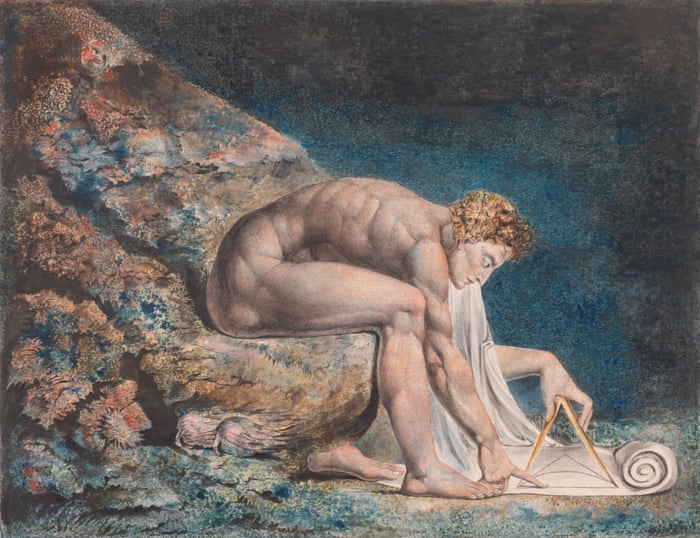
Blake has been described as art’s original free spirit. He did not see it, the way others did. At times he seemed to be railing against science, and the Age of Reason, and invariably ‘the Establishment’. He would feel at home in modern London, I suspect. Guardian journalist, Laura Cumming had this to say, “In his visions, the devil may be tragic, tortured by interminable regret; and God may be violent, uprooting Adam like a weed from the earth. Horror is not always frightening. One illustration of hell shows a smoking serpent front of stage in a kind of glamorous limelight.” He was a pioneer too, he created the technique of relief etching and certainly invited fresh perspective considerations.
Whilst I was thinking about these exhibitions, about the psyche and about perspective, I went to see the film “Official Secrets”. In its way, it too is about perspective – about moral laws and legal laws; about being true to the self or being true to one’s government and nation. It is very good, and not just because I am a huge Keira fan, but because one perspective is about the smallness of the individual, against the immensity of the State. Perhaps it is related to scientific understanding, like the butterfly’s wing sensitivity and its impact. To me it reminds us not to underestimate our value, not to be overwhelmed by a tyrannical superego, to appreciate and value both ends of the scale spectrum, in both the physical word and in the psychic world.
“If you don’t like a person it’s because they remind you of something you don’t like about yourself.” – Sigmund Freud
 Second Innings